
· By Sajeevan (Saj) Veeriah
Engineering case study · 3 min read
From movement to measurement: my ESP32 honours capstone
Integrating Hall-effect sensing, embedded acquisition, Bluetooth and MATLAB into a movement-assessment prototype.
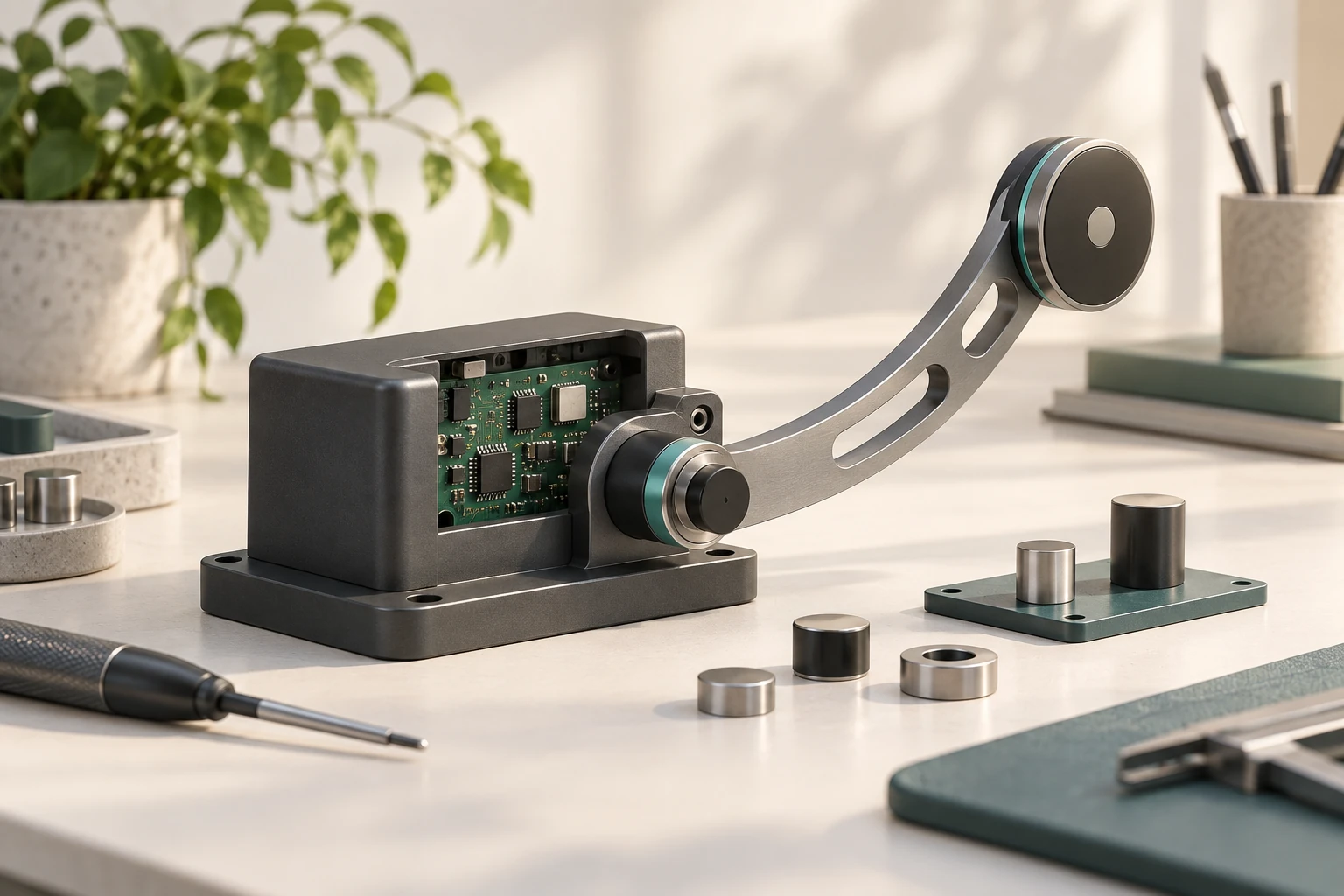
For my mechatronics honours capstone at Deakin University, I developed an ESP32 movement-assessment prototype. The work brought mechanical design, a custom PCB, embedded acquisition and analysis into one measurement workflow.
The central challenge was making the measurement path repeatable and inspectable. A live display is useful, but understanding the sensor behaviour requires a reference and a way to examine the recorded data.
The prototype and my contribution
I designed the device, PCB and enclosure, implemented acquisition and Bluetooth workflows, and developed the analysis and reporting path. Four Hall-effect sensing channels fed the ESP32 at a 100 Hz acquisition rate. The system supported recording, a Bluetooth live display and CSV/PDF reporting.
I completed my Bachelor of Mechatronics Engineering (Honours) in October 2025 with First Class Honours with Distinction. My graduation ceremony was in February 2026. Those dates describe my qualification; they do not imply a clinical validation programme.
Sources: [1]
Keeping acquisition and analysis distinct
I kept the embedded path responsible for acquisition and responsive live feedback, while MATLAB provided the reference-instrument comparison and reporting workflow. This made the recorded measurements available for inspection beyond the device display.
| Stage | Implementation |
|---|---|
| Measure | Four Hall-effect sensing channels capture movement-related behaviour. |
| Acquire | ESP32 firmware samples at 100 Hz and supports recording. |
| Display and export | Bluetooth live display and CSV/PDF output make the observations accessible. |
| Compare | MATLAB analysis checks sensor behaviour against reference instruments. |
Investigating measurement behaviour
My checks covered accuracy, direction, reversal, drift and temperature behaviour against reference instruments in MATLAB. These concerns span both the mechanism and the electronics: a plausible signal can still change with operating conditions or the direction of motion.
The documented outcome is an integrated measurement prototype and a reference-comparison workflow. I have not included numerical error bounds in this article because the supporting raw measurements and analysis outputs are not published here. A sampling rate alone does not establish measurement accuracy.
Sources: [1]
Separating an engineering prototype from clinical evidence
The project title refers to ataxia assessment, but the work described here concerns sensing and prototype engineering. It does not establish diagnostic accuracy, clinical effectiveness or medical-device certification.
A research extension would need a defined measurement endpoint, documented calibration, a repeatability study and an appropriate study design for the intended population. Any work involving participants would also need the relevant oversight and consent. These are future requirements, not activities I am claiming to have completed.
What the capstone taught me
The most useful habit was tracing a result back through the entire measurement chain. Mechanical behaviour, sensing, firmware timing and analysis all influence what an apparent result means. That is the kind of integrated experimental work I want to pursue in robotics and embedded intelligence.
Sources and further reading
First-person engineering case study, not a clinical study or peer-reviewed publication. Qualification details reflect my confirmed completion and award. The illustration is conceptual.